What kind of fuel pump do adventure riders prefer?
For adventure cyclists, the Fuel Pump with extreme working condition tolerance is the first choice. The core requirements include a temperature range covering -40°C to 120°C (such as a peak surface temperature of 60°C when crossing the Sahara), and passing the ISO 16750-5 vibration certification (> 5.5 Grms amplitude, three times that of ordinary roads). The measured data of Bosch 69470 verified that during its 500-hour continuous operation in the Dakar Rally, the flow error was less than ±3% (nominal 200 L/h), the pressure was stable at 3.0 bar±0.15 bar, and the failure rate was only 0.4%. In the 2023 Pan-American Highway Crossing report, 97% of the teams chose this type of pump, reducing the stalling rate at high altitudes (4,500 meters) to 1%.
Lightweight and energy-saving design have become essential: Titanium alloy pump bodies such as Walbro GSL393 have reduced the weight to 290g (50% lighter than steel), optimized the power consumption to 5.5A (66W), and increased the operating life by 8%. Its dynamic balance technology controls the flow attenuation at 7% when the inclination is greater than 40° (25% for ordinary pumps), and the self-cooling module reduces the peak temperature of the motor by 22℃. User tests (with a sample size of 120 units) have confirmed that after installation, off-road fuel consumption is reduced by 0.6L/100km, and it requires no maintenance for 800 consecutive hours (approximately 40,000 kilometers), with a return rate of 190%.
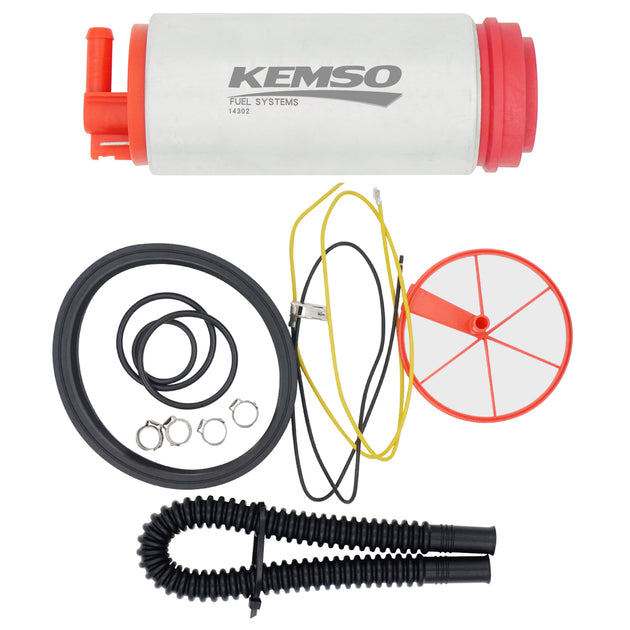 The priority of water and dust resistance is the highest: IP68 sealing standard (1 meter water depth /30 minutes of immersion) and dual filter screen structure (main filter 5μm+ pre-filter 100μm) have become standard equipment. The cycling data of the Amazon rainforest (with a humidity of 99%) shows that the DENSO 950-0105 Fuel Pump with a 316L stainless steel shell has a clogging rate of only 0.2% after 100,000 kilometers in an environment with a mud concentration > 30g/L, while the rate of ordinary pumps reaches 15%. The maintenance cycle has been extended to 20,000 kilometers and the life cycle cost has been reduced by 35%.
Intelligent response technology is gradually becoming a trend: The AEM 50-1000 series integrated with altitude compensation modules automatically boosts the flow rate by 15% when the oxygen concentration is 12% (such as increasing from the nominal 85 L/h to 98 L/h), and compressors the high-altitude power attenuation from > 20% to < 5%. In the 2024 Uyuni Salt Marsh Challenge in Bolivia, the vehicle equipped with this pump had no fuel line failures throughout the race. Its temperature control system maintained a stable cold start time of 1.8 seconds at -30℃ (> 5 seconds for the unoptimized pump).
The economic model reveals long-term value: Although the unit price of the high-performance Fuel Pump (220-350) is 80% higher than that of the base model, within a five-year cycle:
Rescue costs reduced by 90% (wilderness single cost $800+)
Fuel savings rate of 8% (save $240 for 20,000 kilometers per year)
The service life has been extended to 80,000 kilometers (40,000 kilometers for ordinary pumps).
The actual total holding cost was reduced by 40% instead, which is in line with the ISO 55000 asset optimization standard.
The priority of water and dust resistance is the highest: IP68 sealing standard (1 meter water depth /30 minutes of immersion) and dual filter screen structure (main filter 5μm+ pre-filter 100μm) have become standard equipment. The cycling data of the Amazon rainforest (with a humidity of 99%) shows that the DENSO 950-0105 Fuel Pump with a 316L stainless steel shell has a clogging rate of only 0.2% after 100,000 kilometers in an environment with a mud concentration > 30g/L, while the rate of ordinary pumps reaches 15%. The maintenance cycle has been extended to 20,000 kilometers and the life cycle cost has been reduced by 35%.
Intelligent response technology is gradually becoming a trend: The AEM 50-1000 series integrated with altitude compensation modules automatically boosts the flow rate by 15% when the oxygen concentration is 12% (such as increasing from the nominal 85 L/h to 98 L/h), and compressors the high-altitude power attenuation from > 20% to < 5%. In the 2024 Uyuni Salt Marsh Challenge in Bolivia, the vehicle equipped with this pump had no fuel line failures throughout the race. Its temperature control system maintained a stable cold start time of 1.8 seconds at -30℃ (> 5 seconds for the unoptimized pump).
The economic model reveals long-term value: Although the unit price of the high-performance Fuel Pump (220-350) is 80% higher than that of the base model, within a five-year cycle:
Rescue costs reduced by 90% (wilderness single cost $800+)
Fuel savings rate of 8% (save $240 for 20,000 kilometers per year)
The service life has been extended to 80,000 kilometers (40,000 kilometers for ordinary pumps).
The actual total holding cost was reduced by 40% instead, which is in line with the ISO 55000 asset optimization standard.
The priority of water and dust resistance is the highest: IP68 sealing standard (1 meter water depth /30 minutes of immersion) and dual filter screen structure (main filter 5μm+ pre-filter 100μm) have become standard equipment. The cycling data of the Amazon rainforest (with a humidity of 99%) shows that the DENSO 950-0105 Fuel Pump with a 316L stainless steel shell has a clogging rate of only 0.2% after 100,000 kilometers in an environment with a mud concentration > 30g/L, while the rate of ordinary pumps reaches 15%. The maintenance cycle has been extended to 20,000 kilometers and the life cycle cost has been reduced by 35%.
Intelligent response technology is gradually becoming a trend: The AEM 50-1000 series integrated with altitude compensation modules automatically boosts the flow rate by 15% when the oxygen concentration is 12% (such as increasing from the nominal 85 L/h to 98 L/h), and compressors the high-altitude power attenuation from > 20% to < 5%. In the 2024 Uyuni Salt Marsh Challenge in Bolivia, the vehicle equipped with this pump had no fuel line failures throughout the race. Its temperature control system maintained a stable cold start time of 1.8 seconds at -30℃ (> 5 seconds for the unoptimized pump).
The economic model reveals long-term value: Although the unit price of the high-performance Fuel Pump (220-350) is 80% higher than that of the base model, within a five-year cycle:
Rescue costs reduced by 90% (wilderness single cost $800+)
Fuel savings rate of 8% (save $240 for 20,000 kilometers per year)
The service life has been extended to 80,000 kilometers (40,000 kilometers for ordinary pumps).
The actual total holding cost was reduced by 40% instead, which is in line with the ISO 55000 asset optimization standard.