From Quote to Delivery: Planning product inspections in China
Product inspections in China are most useful when they follow a controlled specification from quotation through shipment. Define the lot, characteristics, methods, sampling rules, visit timing, reporting evidence, and release authority before the inspector arrives. The report can then support a clear decision and corrective action rather than serve as a late, informal snapshot.
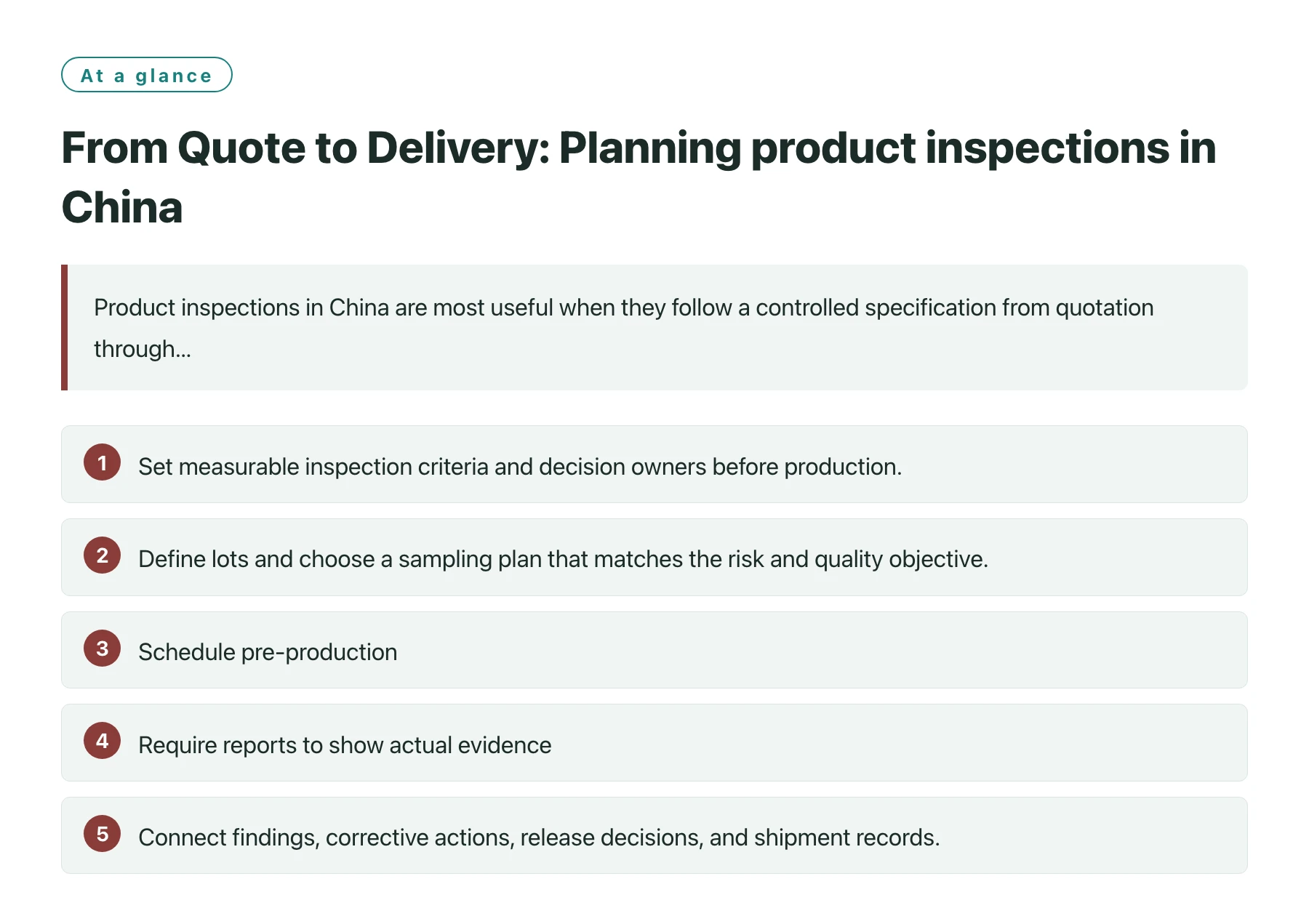
Key takeaways
- Set measurable inspection criteria and decision owners before production.
- Define lots and choose a sampling plan that matches the risk and quality objective.
- Schedule pre-production, in-process, and pre-shipment checks around correctable issues.
- Require reports to show actual evidence, sampling method, and limitations.
- Connect findings, corrective actions, release decisions, and shipment records.
An inspection plan should answer what will be checked, when, using which evidence, and how a failure changes the order. It should be written before schedule pressure makes the criteria difficult to negotiate.
Build the inspection plan while requirements are still negotiable
Inspection begins with a product specification, not a visit date. Identify the item, revision, quantity, lot definition, destination, critical characteristics, methods, acceptance limits, and records required. Mark which properties can be checked visually, measured, tested functionally, or confirmed only through documents. A plan built after production leaves less time to correct an unclear requirement.
Assign each characteristic an owner and a decision path. State who writes the inspection criteria, who performs the check, who receives the report, and who can release or hold the goods. Where engineering, quality, or regulatory judgment is needed, name the qualified reviewer rather than expecting an inspector to infer acceptance from a product description.
Connect inspection to commercial milestones. Decide which checks happen before production, during a process, before shipment, or on receipt. Make clear whether an inspection is a status report, a contractual acceptance activity, or evidence for internal review. These labels affect the authority and consequences of the report.
Select a sampling approach that fits the lot and risk
Define the lot before selecting samples. A lot may be grouped by order, production run, material batch, date, line, or another documented basis. If unlike versions are mixed, one sample plan may hide variation. Separate lots or require stratified selection when traceability and risk analysis call for it.
ISO 2859-1:2026 describes acceptance sampling plans by attributes indexed by acceptance quality limit for lot-by-lot inspection.[1] It provides a structured sampling scheme, but choosing a plan still requires a clear quality objective, correct lot definition, suitable inspection level, and trained interpretation. A sample result is not a guarantee that every unit conforms.
Write down sample size, selection method, defect categories, acceptance and rejection rules, and what happens after a failure. Choose these with a quality professional based on product risk and the relationship between buyer and producer. Do not change sample size or threshold after seeing results unless the approved plan specifies how to proceed.
Schedule the right checkpoints
A pre-production check can verify that approved materials, drawings, tooling, and work instructions are ready. An in-process check may observe a step that becomes difficult to correct later, such as coating, assembly, or packaging. A pre-shipment check can evaluate completed quantities, workmanship, carton marks, and shipping preparation. The checkpoints should address actual failure modes rather than repeat the same superficial review.
Agree the readiness trigger for each visit. Require the supplier to confirm quantity complete, production records ready, access available, and required samples assembled before dispatching an inspector. A visit to an unfinished lot may produce a partial report that is mistaken for final approval unless the status is clearly labeled.
Build time for report review and correction. Identify who responds to a finding, how quickly, and whether reinspection is needed. Leave enough schedule for a failed sample, repacking, document correction, or replacement production; a final inspection date without a remedy window can turn a detectable issue into a shipment delay.
Give inspectors usable criteria and evidence rules
Provide the current specification, drawings, approved sample reference, defect library, and inspection checklist before the visit. Define measuring equipment, tolerance interpretation, test conditions, lighting, fixture setup, and photo requirements where they affect results. Tell the inspector which documents may be copied and which require secure handling.
Ask the report to show observed values and evidence, not only pass or fail. Record item and lot identity, inspection date, sample selection, tested characteristics, actual results, photographs, limitations, and unresolved items. For a measurement, include the value and tool or method where practical; for visual findings, state location, quantity, and defect description.
If the inspector cannot verify something, the report should say so. Missing records, blocked access, non-running equipment, or sealed cartons may limit the conclusion. Distinguish supplier explanation from independent observation and avoid claiming that a check proves a condition that was outside the agreed scope.
Respond to findings and control shipment release
When an acceptance criterion fails, identify affected items and lots, contain the product, notify the decision owner, and record the supplier’s proposed correction. Determine whether the issue is isolated or may affect other production. Any rework, sort, replacement, concession, or reinspection should have a named approver and evidence requirement.
Keep a deviation log that connects each finding to its status, owner, due date, decision, and verification. Close a corrective action only when the agreed evidence has been reviewed. A new photograph may show that one defect was corrected but may not demonstrate that a process problem was prevented; match the closure check to the cause and risk.
Release goods against the approved plan, not schedule pressure. If an authorized person accepts a deviation, specify the affected product and quantity, rationale, scope, and any remaining risk or restriction. Keep the release decision and final report with the purchase order and shipment record.
Link inspection to delivery and supplier learning
At dispatch, reconcile inspected quantity and lot identifiers with carton labels, packing lists, and shipment instructions. Confirm whether any cartons were added, removed, repacked, or reworked after inspection. If the shipment changed, decide whether the prior results still apply or whether an additional check is needed.
After receipt, compare reported results with customer complaints, field returns, or internal defects when available. Feed verified findings back into supplier controls, specifications, sampling plans, and future inspection frequency. Avoid treating one successful inspection as a permanent supplier rating; product and process changes can alter risk.
For product inspection services in China, buyers may review product quality checks in China as a coordination option. Define the assigned inspection stage, sampling and report scope, access arrangements, and decision authority. The buyer’s specification remains the basis for product acceptance.
Sources
Frequently asked questions
Does a passing sample inspection prove every unit is acceptable?
No. Sampling provides evidence under a defined decision rule; it does not examine every unit. Use the results with process controls, lot traceability, and risk-based release decisions.
When should an inspection plan be agreed?
Before production begins. Define product revision, lot, criteria, methods, sample approach, visit readiness, report format, failure response, and release authority in advance.
What should an inspection report include?
Record lot and item identity, inspection date, sample selection, methods, actual results, photographs, missing evidence, limitations, findings, and required next actions.
Who may accept an inspection deviation?
The buyer should name an authorized quality or technical decision owner. The inspector reports evidence; acceptance or concession authority should be assigned in the contract or internal process.