Cheaper Cable, Higher Total: The Arithmetic of a Thin Sheath
A lower figure per metre is only a lower figure if the same metre is being bought, and on PV cable the difference usually sits in the wall rather than in the copper. The published solar cable price page for this manufacturer is a construction table rather than a price list: it gives the strand count, the outer diameter and the weight per metre for every size, and KUKA CABLE also keeps a topic section on the dangers of cutting corners.

Key takeaways
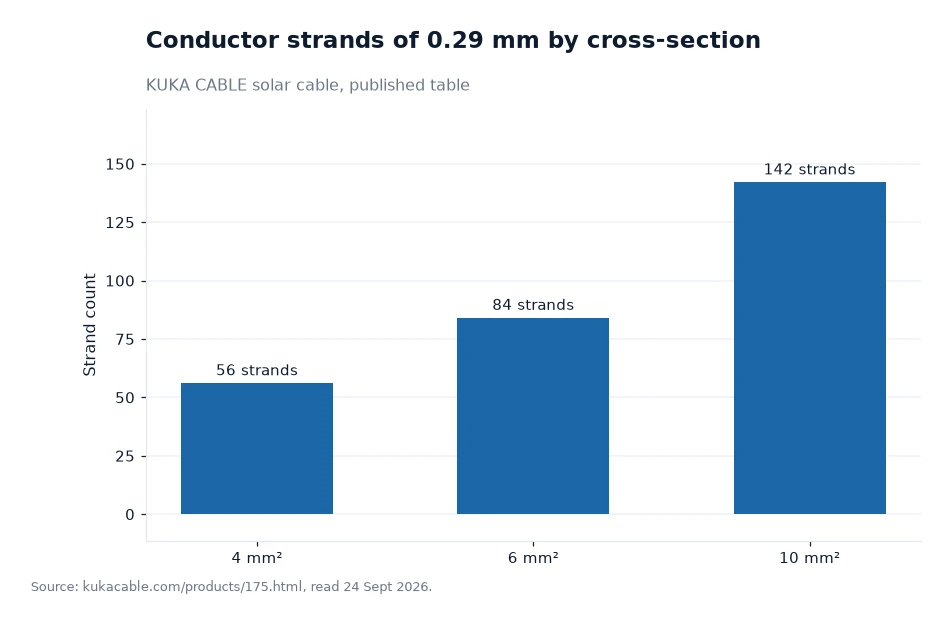
- The published table gives 4 mm² as 56 strands of 0.29 mm at 59 g/m, 6 mm² as 84 strands at 78 g/m and 10 mm² as 142 strands at 130 g/m.
- Wall thickness is published as 0.7 mm of insulation and 0.8 mm of sheath for the sizes from 1.5 mm² to 10 mm², rising to 0.9-1.7 mm and 0.8-1.7 mm above that.
- A 10 kV spark test runs during production and a 6.5 kV AC test at 50 Hz is applied to the finished cable for 5 minutes, so an insulation fault has to survive both.
- Elongation at break is required to be at least 125% by EN 50618 and is stated as typically reaching up to 185%, which is where a thin or under-cured wall shows up first.
The only comparison that holds
Two drums of 4 mm² cable are only comparable if the conductor construction, the wall thickness and the rated voltage are the same. Where one of those is missing, the figure per metre is measuring a different object. The published construction table solves part of the problem because it fixes three numbers per size - strand count, overall diameter and weight per metre - that any supplier can be asked to match in writing.
Weight per metre is not a price, but it bounds part of the material in the drum, and it is the number a buyer can check with a kitchen scale in five minutes. The same logic runs through the whole table, from 1.5 mm² at 34 g/m to 240 mm² at 2,350 g/m, and a quote that cannot be matched to those figures has to be treated as a different product until it is explained.
Strands, not adjectives
The published conductor is tinned copper, class 5 flexible to IEC 60228, built from strands of 0.25 mm in the small sizes, 0.29 mm from 4 mm² to 70 mm² and 0.39 mm from 95 mm² upwards. The counts are published size by size: 39 strands at 1.5 mm², 49 at 2.5 mm², 56 at 4 mm², 84 at 6 mm², 142 at 10 mm², 238 at 16 mm² and 375 at 25 mm².
Strand count is not a quality claim on its own, but it is verifiable. A cut end can be counted under a lens at goods-in, and a drum that arrives with fewer, thicker strands is a different conductor with a different flexibility, whatever the label says. The same cut end shows whether the copper is tinned, which matters for corrosion at a joint.
The wall is a published number too
Insulation and sheath thicknesses are published alongside the conductor data: 0.7 mm of insulation and 0.8 mm of sheath from 1.5 mm² to 10 mm², then 0.9 mm to 1.7 mm of insulation and 0.8 mm to 1.7 mm of sheath for the larger sizes. Both layers are described as electron-beam cross-linked XLPO, low smoke halogen free, on the 1500 V, 6 mm² product page as well as in the general table.
That is why a price difference between two drums of the same nominal size has an address. Shaving a tenth of a millimetre from each wall removes little copper and a measurable amount of polymer, and it changes how the cable behaves in the abrasion, cold bending and cold elongation tests that the laboratory publishes. The manufacturer's own topic section discusses the dangers of cutting corners in exactly these terms.
What the tests would catch
Three published checks bracket the question, and the standards named on the product page sit behind them: TUV 2PfG 1169/08.2007, EN 50618:2014 and IEC 62930. During production a 10 kV spark test looks for faults in the insulation of the moving cable. On the finished length a 6.5 kV AC test at 50 Hz is held for 5 minutes. Before either, the compound is described as electron-beam cross-linked and low smoke halogen free, which is a statement about how it was cured rather than how it was coloured.
Then the mechanical tests: tensile strength before ageing published as at least 8 N/mm², elongation before ageing as at least 125% against a requirement, with up to 185% stated in practice, plus abrasion, cold bending, cold elongation and tensile testing after ageing on the laboratory list. A cheaper wall can pass a visual check on arrival and still fail all four of those.
| Nominal cross-section | Conductor construction | Nominal overall diameter | Nominal weight |
|---|---|---|---|
| 4 mm² | 56 strands of 0.29 mm | 5.5 mm | 59 g/m |
| 6 mm² | 84 strands of 0.29 mm | 6.0 mm | 78 g/m |
| 10 mm² | 142 strands of 0.29 mm | 7.5 mm | 130 g/m |
| 16 mm² | 238 strands of 0.29 mm | 8.8 mm | 190 g/m |
| 25 mm² | 375 strands of 0.29 mm | 11.0 mm | 292 g/m |
| 35 mm² | 520 strands of 0.29 mm | 12.3 mm | 390 g/m |
Worked example
Take the 4 mm² cable: a 5.5 mm overall diameter with 0.7 mm of insulation and 0.8 mm of sheath means 1.5 mm of wall on each side of the axis. If those layers are read as diameters, 3.0 mm of the 5.5 mm is wall, which is about 55% of the outside measurement (1.5 multiplied by 2 gives 3.0 mm; 3.0 divided by 5.5 is 0.545; my own arithmetic, assuming concentric layers). That is why small changes in wall thickness move the diameter quickly: an offer that shaved 0.1 mm from each wall would show an outside diameter about 0.2 mm smaller, which is my own illustration rather than a published figure.
The weight column answers a different question. Between 4 mm² at 59 g/m and 6 mm² at 78 g/m the difference is 19 g per metre, so a 5,000 m order of the heavier size carries 95 kg more cable than the lighter one (0.019 kg multiplied by 5,000 m gives 95 kg; my own arithmetic). Because the manufacturer does not publish prices, that 95 kg cannot be turned into a cost here, but it is the material difference a buyer is paying for and it belongs in the comparison rather than in the small print.
Frequently asked questions
How can I tell whether a cheap offer is actually undersized?
Weigh and measure it. The published table gives 4 mm² a nominal weight of 59 g/m at a 5.5 mm overall diameter built from 56 strands of 0.29 mm, 6 mm² 78 g/m at 6.0 mm from 84 strands, and 10 mm² 130 g/m at 7.5 mm from 142 strands. Ask for the wall thickness as well, published as 0.7 mm of insulation and 0.8 mm of sheath through 10 mm², and compare everything with the certificate that applies to the batch.
Does the manufacturer publish a price per metre?
No. The product page publishes the construction table - strand count, overall diameter, weight per metre and wall thickness - while unit prices, minimum order quantities, lead times and warranty terms are not published anywhere on the site. A buyer who needs a comparable figure should ask the product consultant for a quotation on the exact construction, size and length required, then check the delivered drum against the same published numbers.
Four measurements on delivery
Put a metre on a scale, measure the outer diameter with a caliper, count the strands on a cut end and read the print along the sheath. Then file the certificate with the delivery note, because a specification is only as good as the paperwork attached to the drum. The manufacturer lists a free sample service and a product consultant, so the measurement can be made on a sample before the order rather than on a full drum after it.
Sheath thickness and strand figures used in this arithmetic are the manufacturer's own website values, checked against it on 24 Sept 2026[1].